Saturday, February 11, 2012

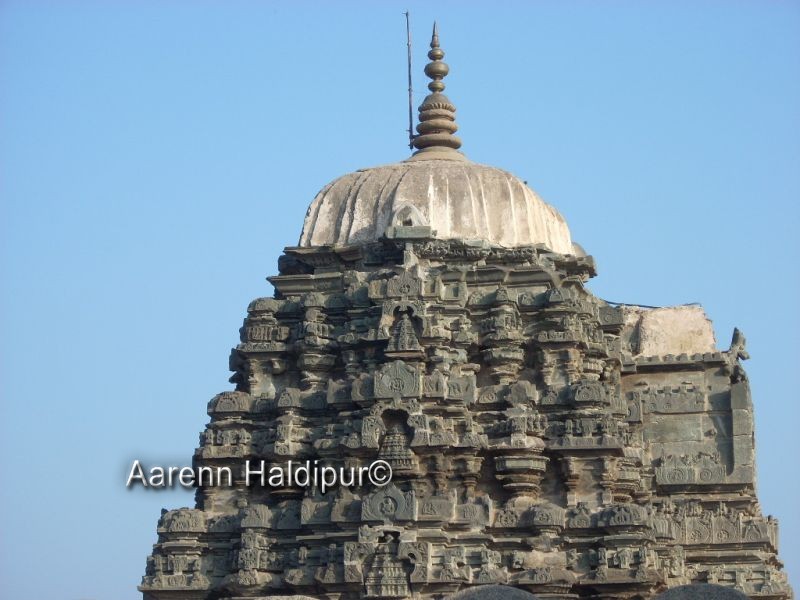
Temples of Karnataka 5 - Harihareshwara @ Harihara


The temple was built in the year 1224 by ‘Polalva’ a minister of Hoysala King Veera Narasimha II. It is believed that the consecration of Lord Harihara, a fusion of Lord Shiva and Lord Vishnu was carried out later in the year 1268 by ‘Soma’ who was a commander of Hoysala King Narasimha III.


The temple stands on the banks of river Tungabhadra and is affected to a great extent by encroachment. The road leading to the temple is very narrow and crowded.


 Highlights:

  • The temple consists of an attractive Sabhamantapa, Navaranga, Antarala and Sanctum.
  • The Navaranga has 2 more entrances on either side. These entrances have attractive Mukhamantapa but remain closed always.
  • The Mukhamantapas on either side of Navaranga have attractive carvings on outer sides similar to those on the Sabhamantapa.
  • The doorjamb of Antarala is of Trishakha type consisting of perforated windows and a Gajalakshmi motif on the lintel.
  • The door of Sanctum has simple decorations.
  • The original Shikhara (Tower) has collapsed long back.
 

Bottomline: According to a legend, a demon named Guhasura once lived in these parts. He successfully appeased Lord Brahma and obtained a boon, by virtue of which, it would be impossible for either Hari(Vishnu) or Hara(Shiva) to kill him. In order to eliminate Guhasura, Vishnu and Shiva together took the form of Harihara and killed the demon.

Source: Wiki

Thursday, February 9, 2012

Temples of Karnataka 4 - Someshwara @ Kodikoppa


This temple is 'whitewashed' in full by the devotees of Kodikoppa. Apart from that the temple is intact. Kodikoppa is referred to as ‘Kirunareyangal’ in the 2 inscriptions found here dated AD 1121 and AD 1144.

Colourfull Door!

Highlights:

  • It is a simple structure consisting of Mukhamantapa, Navaranga, Antarala, Garbhagruha (Sanctum) and a Shikhara (tower) of Kadamaba Nagara style.
  • The temple though now called Someshwara was also known as Brahmeshwara temple and also by the name of Mallikarjuna Temple.
  • Small Shivalinga is in the sanctum.
  • Door of Navaranga is of Panchashakha type consisting of various creeper designs which are now defaced due to the red and green paint.
  • Antrarala door consists of Jalandhras (perforated windows) on both sides and top.
  • There are six Devakoshthas (niches) in Navaranga and all are empty.

Trademark Western Chalukya Style Pillars
AD 1144 Inscription
Bottomline: There is no information regarding exact year of construction. But the mention in the AD 1144 inscription that one ‘Molleya Brahmaiah’ as the person who constructed this temple indicates that the temple was constructed some time before AD 1144.

Source: ASI

Monday, January 30, 2012

Temples of Karnataka 3 - Amrutheshwara @ Annigeri


Annigeri is historically an important place. Over 25 inscriptions have been found here. In these inscriptions Annigeri is referred to as ‘Anyatatakka’ and ‘Annigeri’ as well. Historians have learnt that this place was the capital city of Western Chalukyan king Someshwara IV and Kalachuri king Bijjala. The oldest inscription is dated to the year AD 750 to the time of Badami Chalukya King Keertiverma II.


Famous Kannada poet Pampa was born here in AD 902. Among the many old temples of Annigeri, Amrutheshwara Temple stands out. It was constructed during the reign of Western Chalukyan king Someshwara I in the year 1050.


Highlights:
  • This east facing temple consists of Mukhamantapa, Sabhamantapa, Navaranga, Antarala and Garbhagruha (Sanctum).
  • Temple has 2 Shikharas – one atop the Sanctum and the other a smaller one atop the Mukhamantapa.
  • The spacious Sabhamantapa which has doors on all 4 sides was a later addition.
  • The main entrance of the temple opens to Navaranga.
  • From Navaranga there are 2 openings on either side – one leading to Antarala on its way to Sanctum and the other opening into Sabhamantapa.
  • The main door of the temple is of Saptashakha type and the craftsmanship seen here is the main attraction of the temple.
  • The outer wall of the temple has typical Western Chalukya style work consisting of some Shikharas and Makaratoranas.
 

Bottom Line: No photography is allowed inside the temple. The villagers themselves raised objection when I took out the camera. The ASI guy who was occupied somewhere else rushed towards me after hearing the arguments and asked me not to take any photos. Though, when he and certain villagers are not present within the temple premises then nobody stops visitors from taking photos. I was there at the wrong time.

Source: ASI